Efficiently constructs a multi-layer terra::SpatRaster from a
data.frame/data.table that contains one column of raster cell
identifiers and one or more columns of values. The function performs a
complete join against all cell indices in the template raster (so every cell
is present exactly once), fills missing cells with NA, and assigns all
layers in a single block write for speed.
rastFromDF(df, rasTemplate, cols = NULL, cellIDcol = NULL)Arguments
- df
A
data.frameordata.tablecontaining one column for raster cell indices (name matching"pixel|cell"; e.g.,cell,cellID,pixelID) and one or more columns of values to become raster layers.- rasTemplate
A terra::SpatRaster whose geometry (extent, resolution, rows/cols, CRS) defines the output grid.
- cols
NULLor a character vector of column names indfto use as layers (order preserved). IfNULL, the function uses all columns except the detected cell/pixel ID column.- cellIDcol
A single string with the column name of the cellID/pixelID. Default is
NULL, which will use the first column that matches a grep on"pixel|cell".
Value
A terra::SpatRaster with one layer per selected value column.
Cells not present in df are filled with NA. The raster shares the
geometry of rasTemplate.
Details
This function is designed as a fast "inverse" of terra::as.data.frame()
for rasters to be made from "sparse" data.frame/data.table objects with the
following workflow:
Identify the pixel/cell ID column in
dfby searching for a column name that matches"pixel|cell"(e.g.,"cell","cellID","pixelID").Create a complete index of all cell numbers for
rasTemplateusingterra::ncell()and join withdf, so any non-provided cells becomeNA.Create a multi-layer raster with the same geometry as
rasTemplateviaterra::rast(), one layer per value column, and write all values at once usingterra::values().
Notes and gotchas
The ID column must be a 1-based integer cell index consistent with
rasTemplate's grid.If the input has duplicate cell IDs, the data.table join semantics will replicate rows; the final
terra::values()call expects exactly one row per cell. Deduplicate beforehand if necessary.The argument
cols(a character vector) can be used to select a subset of columns to create in the returned SpatVector.The number of layers created equals the number of selected value columns. Layer names follow the column names.
Examples
library(terra)
library(data.table)

# Template raster (3x3 grid)
tmpl <- rast(nrows = 3, ncols = 3, xmin = 0, xmax = 3, ymin = 0, ymax = 3,
             crs = "EPSG:4326")

# Sparse table: provide values for a subset of cells
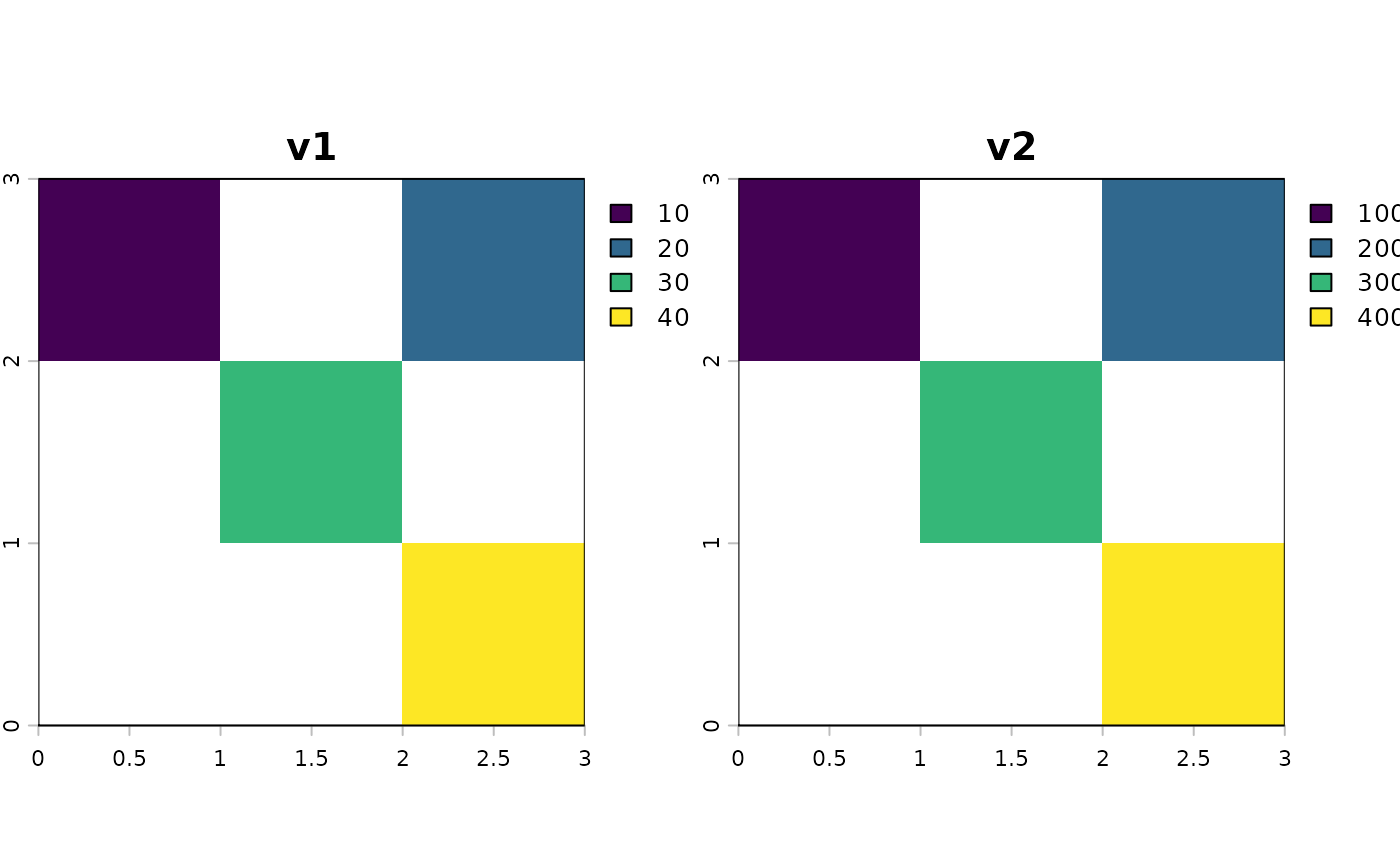
df <- data.table(
  cell = c(1L, 3L, 5L, 9L),
  v1   = c(10, 20, 30, 40),
  v2   = c(100, 200, 300, 400)
)

r <- rastFromDF(df, tmpl)
r
#> class       : SpatRaster
#> size        : 3, 3, 2  (nrow, ncol, nlyr)
#> resolution  : 1, 1  (x, y)
#> extent      : 0, 3, 0, 3  (xmin, xmax, ymin, ymax)
#> coord. ref. : lon/lat WGS 84 (EPSG:4326)
#> source(s)   : memory
#> names       : v1,  v2
#> min values  : 10, 100
#> max values  : 40, 400
terra::plot(r)  # remaining cells are NA